


Case study 03 // verification // performance // identity

Engineering craft_

Four rules run through both products and this site: deterministic cores, tests against independent oracles, byte budgets and assets rebuilt from source. This page shows the evidence for each, then takes apart the page you are reading.

Praise The Code banner: orange rule, the modular praise.tc_ signature and the line Software, Tools, Games, São Paulo.
Banner // 1128×191 SVG generated from tokens.json, 4.3 KB.

01 // Tooling

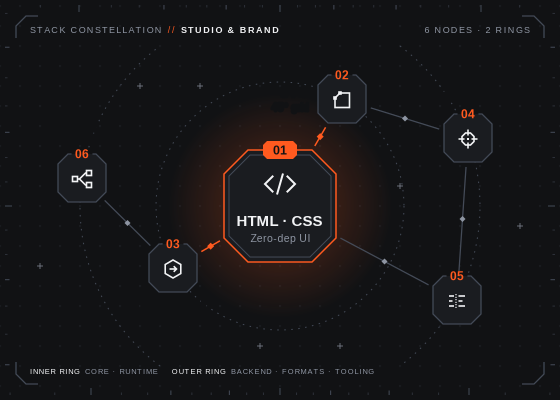
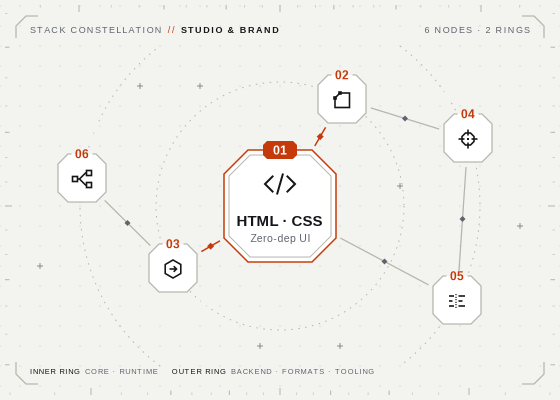
Language and studio tooling constellation

The tools behind the brand, this site and the release checks. Select a node to read its role.

Studio tooling constellation: HTML and CSS at the hub, SVG and Node ESM on the inner ring, Python, JSON tokens and Actions CI on the outer ring. Studio tooling constellation: HTML and CSS at the hub, SVG and Node ESM on the inner ring, Python, JSON tokens and Actions CI on the outer ring.

01 // HTML + CSS // zero-dependency UIEach page of praisetc.com is hand-written HTML with one shared stylesheet and one deferred script. No framework, no bundler, no webfont.

02 // Principles

Four rules, with evidence

Rule 01

Same input, same output

  • Dawnbringer's battle simulation runs on an integer clock (TICKS = 5342931457063200) with no random number generator in game/core/battle/.
  • gen_sfx.py uses its own seeded generator, never the system RNG, so a seed always writes the same sound.
  • OpenStrut gives each IFC element a deterministic 128-bit GlobalId, so a re-export keeps BCF comments attached.

Rule 02

Test against an oracle the code did not produce

  • OpenStrut's expected values come from Prof. Paulo Bastos' published examples (UNESP), hand calculations, numerical integration or the 1991 SISTRUT binary in DOSBox-X.
  • Its IFC files roundtrip through IfcOpenShell, web-ifc and @ifc-lite/parser.
  • Dawnbringer's art tests check backdrops against palette.json, the written 32-colour spec.

Rule 03

Every format has a byte budget

  • OpenStrut's IFC4 writer is 25.0 KB (10.0 KB gzip) where web-ifc ships a 1.6 MB .wasm.
  • gen_sfx.py cites a 12 MB budget for the web build.
  • This site: one stylesheet, one script, no webfont. The numbers are in the next section.

Rule 04

Rebuild from source, pin what you cannot rebuild

  • Dawnbringer's CI pins Godot 4.5-stable and checks its SHA-512 before any test runs.
  • gerar_praisetc_svg.mjs regenerates the brand's 14 SVGs and 23 PNGs from tokens.json and fails on a wrong size or a text outside the safe area.
  • OpenStrut's bun run check chains route generation, tsc, oxlint, oxfmt and Vitest.

03 // This site

Performance architecture of praisetc.com

The page you are reading is the test case. Each decision below has a reason you can check in the page source.

Frameworks
0. Hand-written HTML, one site.css and one deferred site.js with no dependency.
Fonts
0 webfonts. Segoe UI, Inter or the system sans; Cascadia Mono, JetBrains Mono or the system mono.
Third parties
0 requests. No analytics, no CDN, no embed, no tracking pixel.
Navigation
Speculation Rules with prerender and moderate eagerness: hovering a link starts rendering the next page.
Layout
Every <img> declares its width and height, so the browser reserves space before the file arrives.
Rendering
content-visibility: auto skips sections below the fold on first paint. Animations touch only transform and opacity and stop under prefers-reduced-motion.
Theme
A 120-byte inline script applies the saved theme before first paint. Diagrams ship as dark and light SVG pairs, so a switch makes no request.

Measured on this build

PageTransfer3rd-partyCLS
Overview327.4 KB00.000
Dawnbringer519.1 KB00.000
OpenStrut533.9 KB00.000
Engineering77.3 KB00.000

Headless Chrome audit across 1280×900 and 390×844 in both themes on a local server (warm local LCP under 360 ms; local timings leave out network latency). Transfer counts every response after scrolling the full page, lazy images included. site.css is 22.7 KB and site.js 7.2 KB before compression.

04 // Identity

Terminal PTC visual system

The three letters of Praise The Code on one modular grid, followed by a cursor. The cursor is the only colour in the mark.

ptc_ mark on Carbon Zinc with a Signal Orange cursor and a fading dot grid.
Dark // Signal Orange #FF5A1F
ptc_ mark on Warm Concrete with a Deep Signal cursor and a Formwork Grey dot grid.
Light // Deep Signal #C43A0A
Canvas
400 px
Module
18.75 px: exactly 3 px at 64, 6 px at 128 and 12 px at 256
Stroke
1 module; x-height of 5 modules
Widths
p 4, t 3, c 3, cursor 2, with 1-module gaps: 15 modules, 70.3% of the canvas
Chamfer
45° at every bend: 1 module outside, 0.4 inside
Generator
gerar_praisetc_svg.mjs: 14 SVGs and 23 PNGs from tokens.json, rendered in headless Chrome with no npm package

Contrast pairs from tokens.json

Select a pair to preview it. Ratios are the values stored in the token file.

Praise The Code_17.03:1 // AAA // Bright Aluminium #F3F4F6 on Carbon Zinc #111214. Body text on dark.

05 // Experiments

Experiments

JEV-Factorio

An experimental agent that plays Factorio 2.0. It stays an experiment: no case study and no architecture claims until it has results we can measure.